
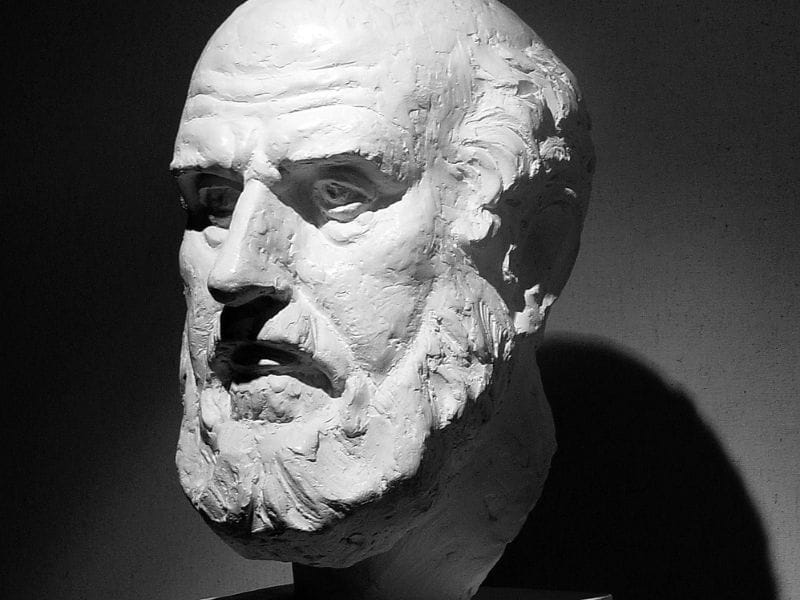
They say he was born around 460 BCE, somewhere near the ancient harbor. Back then, most believed disease was punishment — invisible hands of angry deities. Hippocrates looked closer. He watched the weather, the water, the way people lived. Patterns began to form. Illness, he realized, came from nature itself, not from divine wrath.
In time, he gathered students. Together they observed, compared, and wrote. The school he founded here turned curiosity into method — medicine built on evidence, not fear.
And then there’s the Hippocratic Oath, still whispered by young doctors in every language: to help, not harm; to treat with honesty and kindness. Simple words, yet they changed the world. You can still feel their weight when you study the story of Hippocrates in Kos.
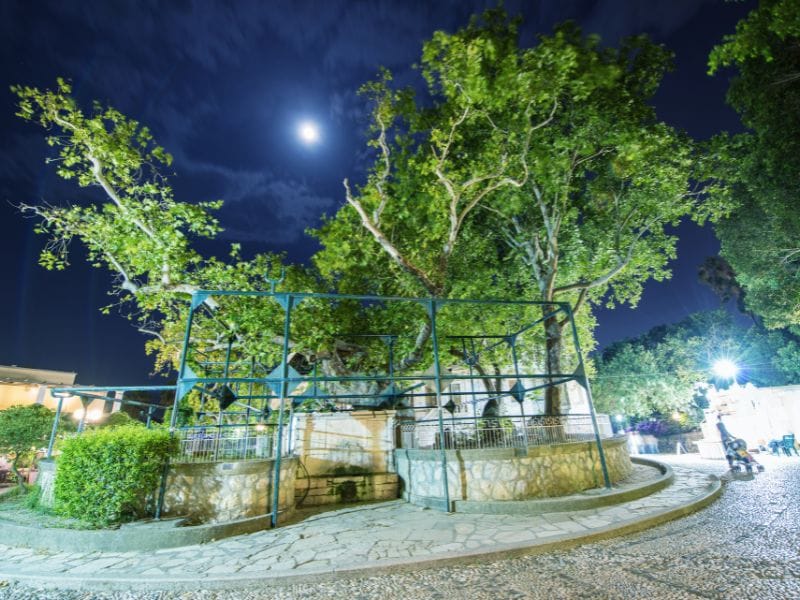
In the heart of Kos Town grows a massive plane tree. Locals will smile if you ask — that’s Hippocrates’ tree, they’ll say, as if it were a member of the family. Whether or not he actually taught beneath its branches doesn’t really matter. Sit there for a while and you’ll understand why the story endures.
The trunk twists like time itself, its roots pushing into the stones of centuries past. Around it, cafés hum softly, tourists pass by, and the shadow of the tree stretches across medieval arches. Under that canopy, the idea of healing feels less like science and more like faith in human care.

Drive a few minutes uphill from town and you’ll see marble stairs shining in the sun — the Asclepieion. From up there, the Aegean looks endless, and so does the imagination that once filled this place.
This was Hippocrates’ world: an open-air school, part temple, part hospital. Here, his students examined patients, prepared herbs, and wrote on tablets of wax or stone. Imagine them at dusk — the sound of sandals on marble, the murmur of study, the wind moving through the cypress trees.
The Asclepieion united science and spirituality. Healing the body meant healing the soul, and both were treated with equal respect.
Kos hasn’t forgotten. Near the plane tree stands the Hippocratic Museum, its small rooms filled with ancient tools, scroll replicas, and the quiet pride of an island that changed medicine forever. The Hippocratic Foundation hosts lectures and conferences where doctors still debate the ethics that began here — honesty, empathy, restraint.
Even now, every time a graduate recites the Hippocratic Oath, they unknowingly send a little piece of Kos out into the world. A fragment of sunlight, a promise made long ago under a plane tree that still grows.
To follow Hippocrates in Kos is to walk a fine line between myth and history. You see the ruins, yes, but also something living — the spirit of inquiry that made people question what was once unquestionable.
Stand beneath the plane tree, climb the terraces of the Asclepieion, listen to the cicadas and the breeze. You’ll realize that Hippocrates’ greatest lesson wasn’t just about medicine; it was about curiosity and compassion.
Knowledge, after all, heals best when it listens.
We use cookies to improve your experience on our site. By using our site, you consent to cookies.
Manage your cookie preferences below:
Essential cookies enable basic functions and are necessary for the proper function of the website.
Stripe is a payment processing platform that enables businesses to accept online payments securely and efficiently.
Service URL: stripe.com (opens in a new window)
WooCommerce is a customizable eCommerce platform for building online stores using WordPress.
Statistics cookies collect information anonymously. This information helps us understand how visitors use our website.
Google Analytics is a powerful tool that tracks and analyzes website traffic for informed marketing decisions.
Service URL: policies.google.com (opens in a new window)
SourceBuster is used by WooCommerce for order attribution based on user source.
You can find more information in our Privacy Policy and Privacy Policy.