
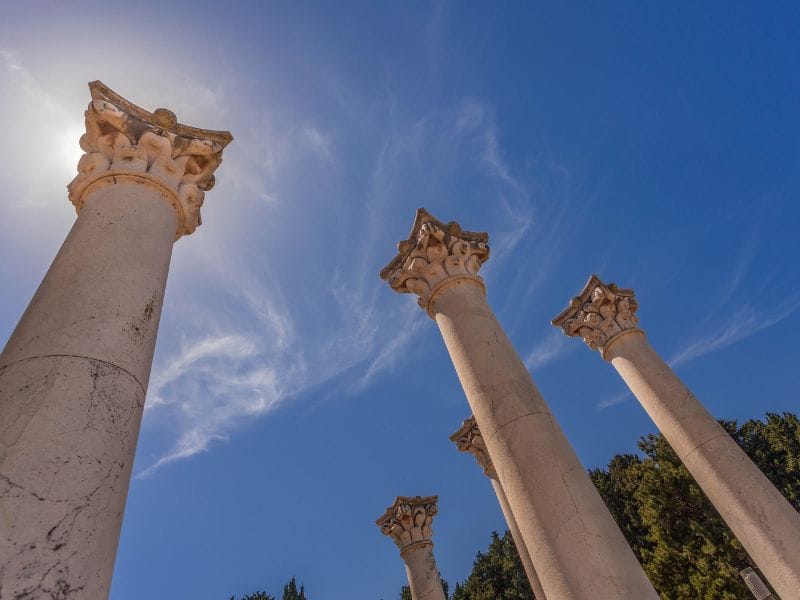
Few places reward a photographer’s patience quite like the Asclepieion of Kos. Standing among its marble terraces, you can almost hear the whisper of old prayers carried on the breeze. The view opens wide to the Aegean, and the light — that ever-changing Greek light — plays on the stones as if it has its own memory.
If you love photography in Asclepieion, every visit feels different. The scene shifts with the hours, the season, even your own mood. You raise the camera, and somehow myth and sunlight align just long enough for one perfect frame.

Morning arrives softly here. Pale light settles on the columns, and the ruins seem half-asleep — a gentle time for calm, pastel images. Around midday, the sun grows sharp and bright, cutting strong lines across the stairways and statues. It’s not easy light, but it reveals every texture.
Then comes the hour everyone waits for. Late afternoon slides into gold, and the sanctuary seems to breathe again. Shadows stretch across the steps; the marble warms to amber. This is the heart of photography in Asclepieion — the moment when everything glows and even silence feels luminous.
Stay a little longer if you can. At sunset, the sea turns copper, and the sky fades through rose and indigo. Sometimes, as night rises, the first stars appear right above the temple’s silhouette — a final gift for those who linger.
Start at the amphitheatre steps and look outward; the terraces tumble down toward the sea in perfect harmony. Then climb to the middle level, where the altar courtyard catches the last sun — the marble turns honey-gold here.
Higher still, between the Doric columns, frame the horizon through the stone — the contrast of time and distance is breathtaking. Near the grand staircase, you’ll find an ideal place for panoramic shots, the whole sanctuary laid out like a sculpted landscape.
And don’t forget the hidden edges: narrow paths, bits of shadow, weathered carvings half-covered by grass. These quiet corners often give you the most personal photographs — small details that tell a bigger story.

The sanctuary almost composes itself. Its lines — staircases, terraces, colonnades — guide your eye naturally through the frame. Try stepping back and letting those shapes lead the viewer. Or frame through a broken archway to create depth.
Symmetry brings calm; asymmetry adds movement. Both work here. If you include a figure — perhaps a visitor walking slowly up the steps — the scene comes alive with scale and emotion. Good photography in Asclepieion isn’t just about perfect light; it’s about catching how the place feels to stand in.
Bring water, sunscreen, and patience. The light is worth waiting for. Avoid climbing on fragile stones or crossing ropes — the ruins deserve care.
If you use a drone, check for permits first; many Greek archaeological sites are restricted. Mornings and late evenings are quietest, giving you cleaner shots and a sense of peace you can’t find in crowds.
And one small trick: turn off the camera for a moment. Look around without the lens. Often, that pause helps you see what you’ve been missing — the glint of the sea, a bird passing between columns, or a shadow that lasts only a breath.
The Asclepieion isn’t just an archaeological site; it’s a conversation between light, stone, and time. Every photograph taken here is part of that dialogue.
To master photography in Asclepieion is to learn how to wait — for clouds to drift, for colours to deepen, for a column to catch fire in the last glow of day. You don’t capture the sanctuary; it reveals itself, one heartbeat at a time.
In those moments, as the sun drops behind Kos and the ruins fall into soft shadow, you understand what every ancient pilgrim once felt: healing not only for the body, but for the spirit — found in light, in stillness, and in the perfect frame.
We use cookies to improve your experience on our site. By using our site, you consent to cookies.
Manage your cookie preferences below:
Essential cookies enable basic functions and are necessary for the proper function of the website.
Stripe is a payment processing platform that enables businesses to accept online payments securely and efficiently.
Service URL: stripe.com (opens in a new window)
WooCommerce is a customizable eCommerce platform for building online stores using WordPress.
Statistics cookies collect information anonymously. This information helps us understand how visitors use our website.
Google Analytics is a powerful tool that tracks and analyzes website traffic for informed marketing decisions.
Service URL: policies.google.com (opens in a new window)
SourceBuster is used by WooCommerce for order attribution based on user source.
You can find more information in our Privacy Policy and Privacy Policy.